Michigan public decisions · October 18, 2026
Mason and Vevay Township
The data center annexation petition, the public process, and the decisions still ahead
Watch the explanation
Watch the full story.
5:50 · 16:9 wide
The data center proposal at Mason’s edge

Follow the decision and the evidence
Chapter 1
Begin with the petition and the place
A group of property owners has asked the State Boundary Commission to move territory from Vevay Township into the City of Mason. The petition is connected to a proposed data center and the owners' stated need for municipal utilities. The Commission found the petition legally sufficient on October 7, 2026. The next identified step is a public hearing, rather than an already effective boundary change.23
The actual proposal is an owner petition
The proceeding is identified as 26-AP-01. The revised cover letter, dated August 6 and revised August 20, 2026, describes a petition by owners of land in Vevay Township. It invokes MCL 117.9(7)(b), the owner-petition provision of the Home Rule City Act, and the State Boundary Commission process. A September 9 state staff review identifies the same statutory route. These records establish a more specific procedural description than saying that the city simply voted to take township land.23
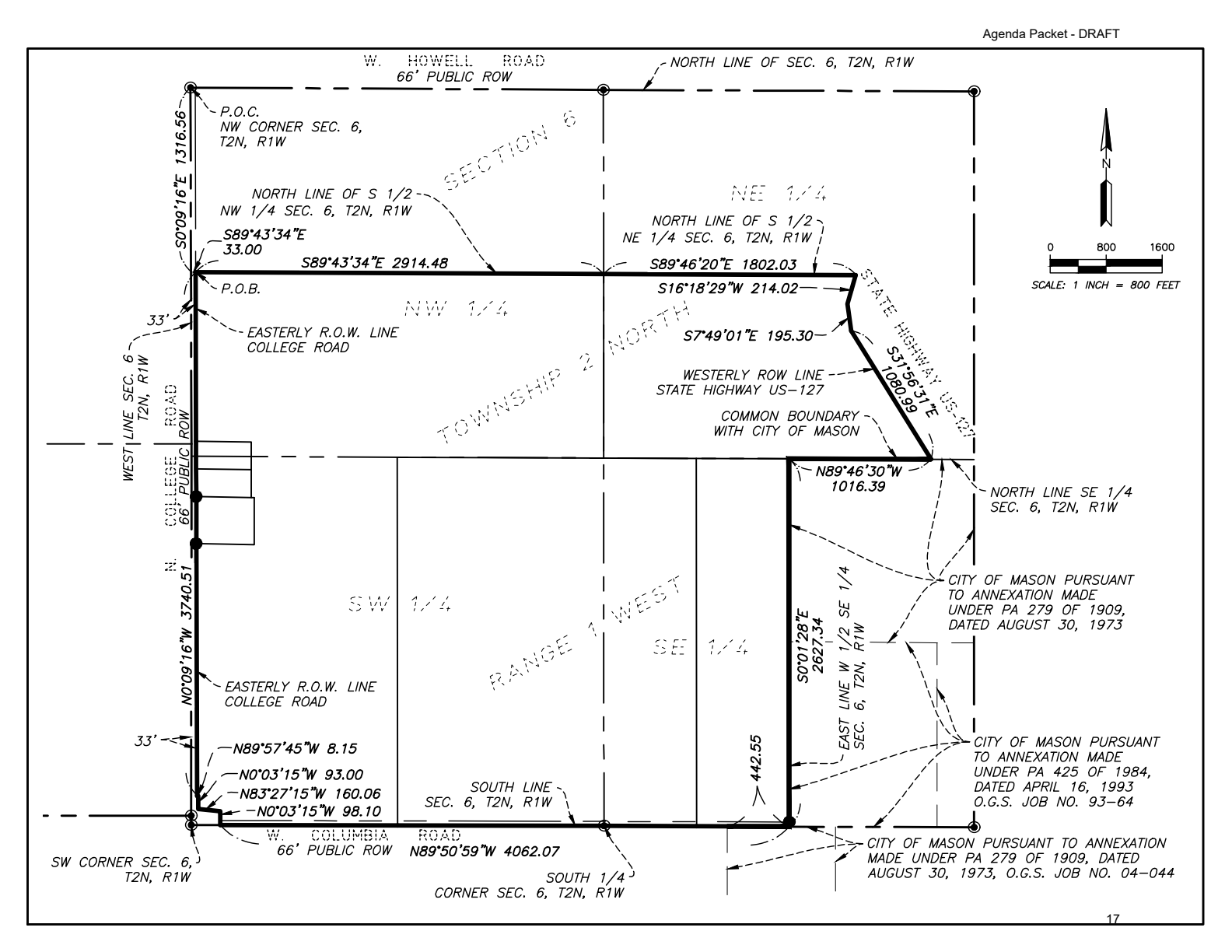
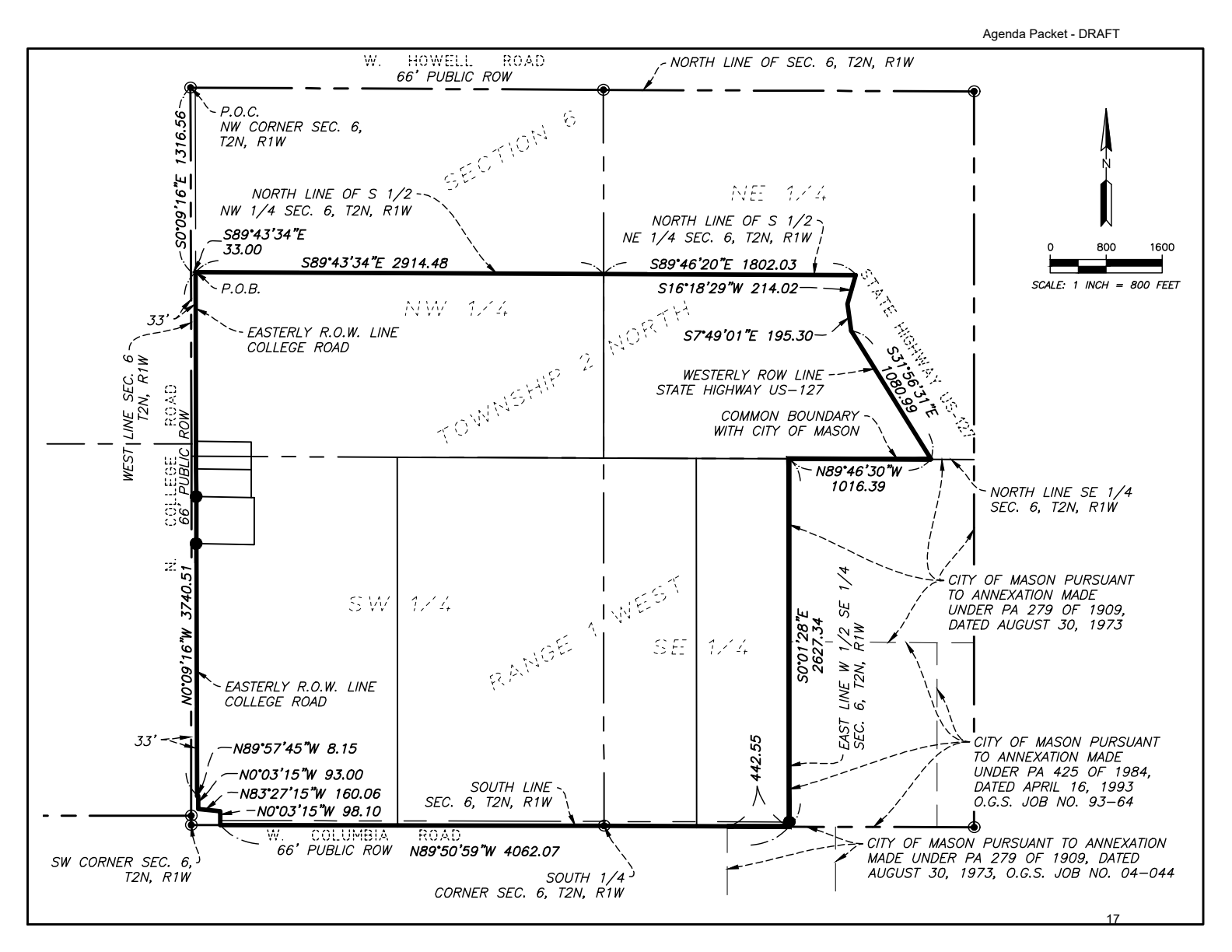
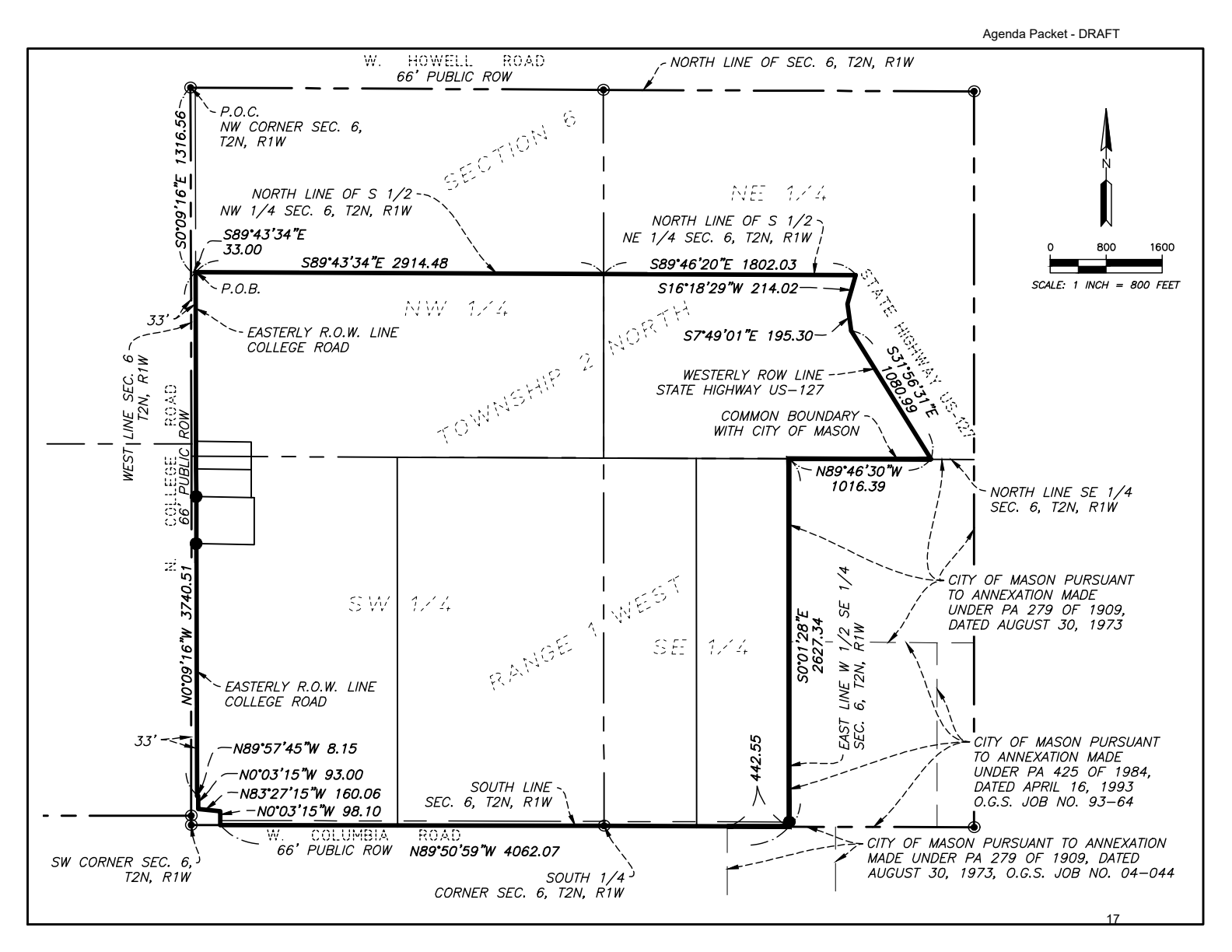
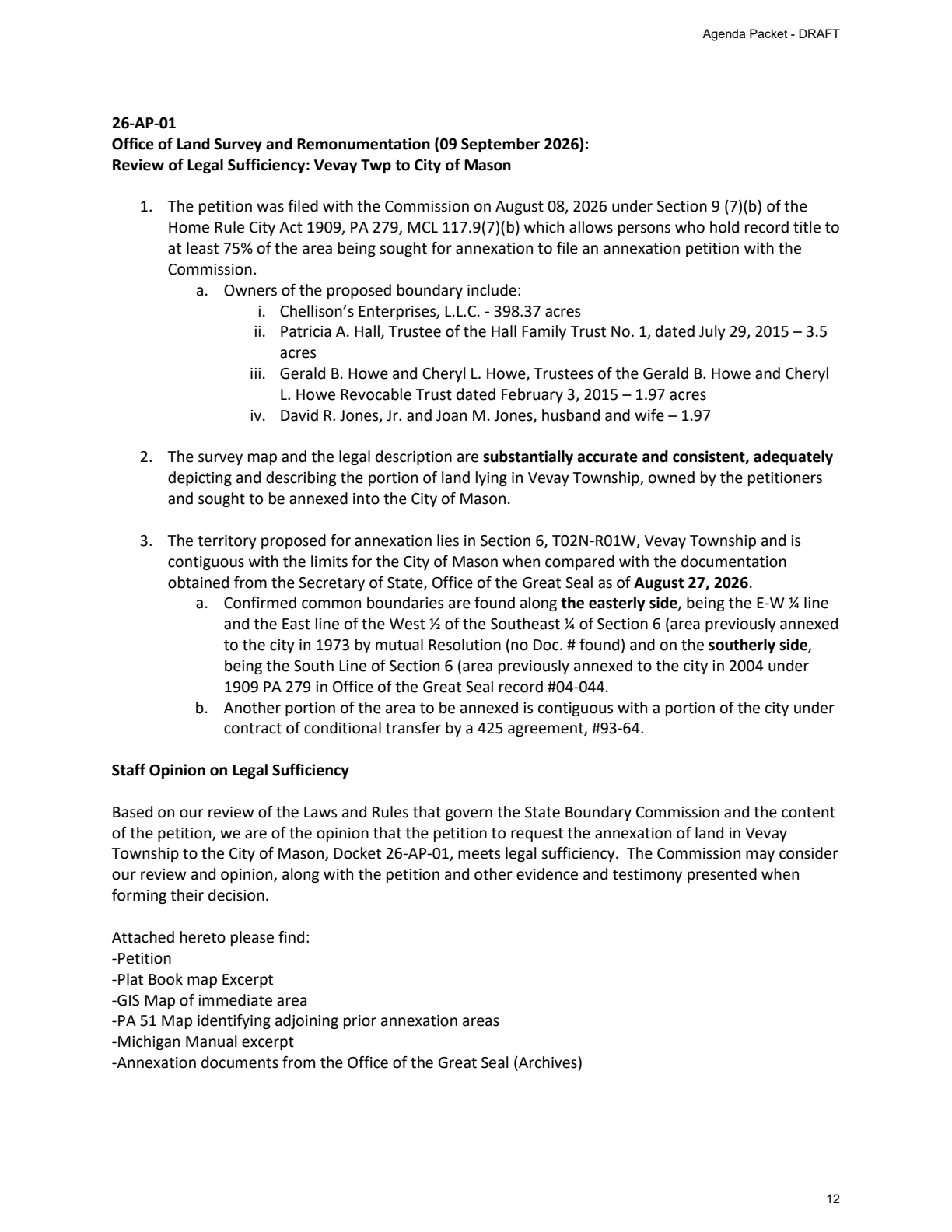
The petition describes 405.81 acres and specifies an exception for a 33-foot right-of-way along the western boundary that would remain in the township. The state staff review lists the ownership components and finds the survey and legal description substantially accurate and consistent. Use the legal description and survey together when identifying the territory. An approximate acreage in a headline should not replace the submitted boundary.23
The territory is in section 6 of Vevay Township. The survey depicts College Road along the western side, Columbia Road along the southern side, and the relationship to US-127 and prior boundary actions. It provides an authentic geographic reference without assuming that the whole survey area is already a permitted data-center footprint.23
Ownership, proposed development, and operation are different roles
The state review identifies Chellison's Enterprises, LLC as an owner of 398.37 acres and lists additional ownership interests in the requested territory. The petitioners say they collectively hold the entire described property. The report uses the ownership record to explain the petition; it does not identify private residents by name or treat a property-owning entity as proof of the eventual data-center operator.23
The cover letter argues that the location is suitable for a large-scale computer storage and data center and that city utilities are needed for the proposed development. Those are the petitioners' reasons for annexation. They do not establish a final operating plan, a utility-capacity determination, or an approval to construct every part of the proposed facility.23
Legal sufficiency is an important but limited decision
The October 7 state correspondence states that the petition met legal-sufficiency requirements and identifies a public hearing as the next step. The September staff review addresses the statutory petition basis, ownership information, survey consistency, and contiguity. That review should be distinguished from the later inquiry into whether the proposed annexation is reasonable under the statutory criteria.23,11,12
A useful status description is therefore “legally sufficient petition proceeding toward a public hearing,” qualified by the date of the record. “Annexation approved” would imply more than these documents establish. “Data center approved” would add a separate unsupported implication.23,8
Chapter 2
Three processes with different legal effects
Zoning determines permitted land use
Mason's Ordinance 266 addressed a proposed technology-innovation zoning district. The city's project page records its repeal on March 16, 2026, and links the preceding ordinance and council material. The final March minutes establish the council action. That ordinance history belongs in the account because it explains why residents may remember a referendum controversy before the present state boundary proceeding.18,5
A land-use ordinance, however, is not an annexation order. Questions about permitted uses, site design, setbacks, and operating standards arise under the relevant zoning and development authorities. Moving a boundary can change which government exercises a power, but the boundary action and the later exercise of that power still need separate records.18,8
PA 425 provides a contractual route
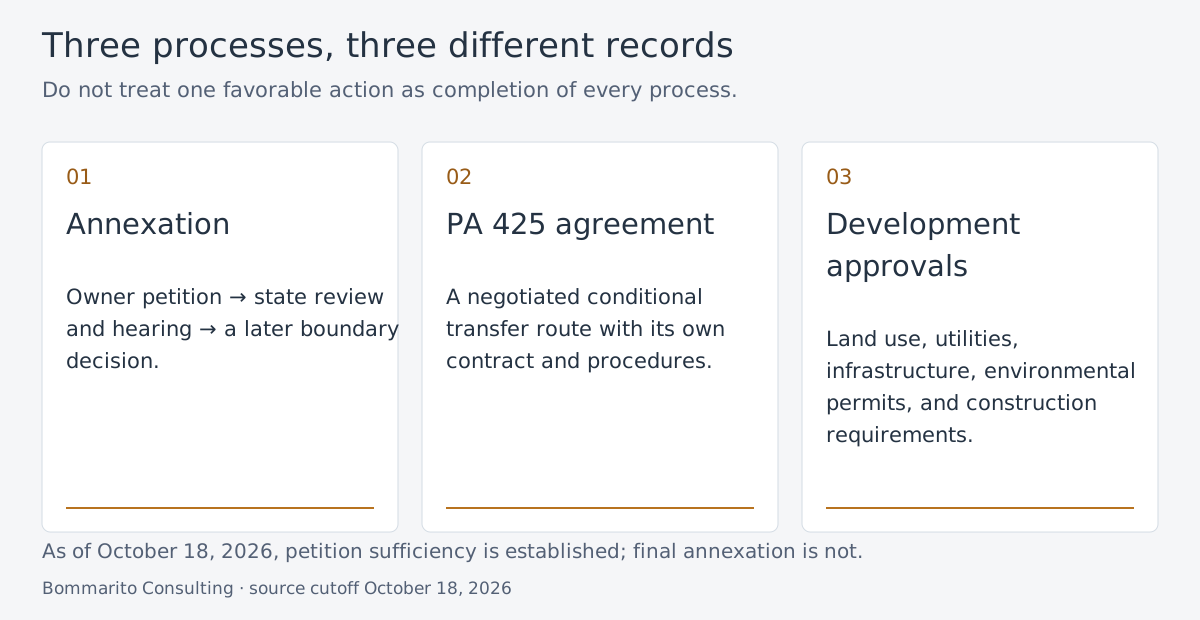
Public Act 425 of 1984 authorizes intergovernmental conditional transfers of property by contract for the purposes specified in the act. Its framework is different from a permanent annexation proceeding. The act addresses local agreements, hearings, referendum mechanisms, and contract provisions. The precise division of services, powers, charges, obligations, and any revenue arrangement depends on the actual lawful contract.14,15,16,17
Vevay's June 10 minutes record a motion not to enter discussions or explore a PA 425 agreement with Mason to conditionally transfer the section 6 parcels. The roll call records five affirmative votes and no negative votes. The motion was about entering discussions; it should not be represented as a township decision finally resolving every possible annexation petition or development application.33
The city manager's June 12 memorandum describes the city's negotiation history and the consequences she understood would follow the township action. It is an official account by one participant in the negotiations. Use it for that account, alongside the township's actual motion, rather than treating its characterization of the other government's intentions as a shared finding.31,33
The present route is statutory annexation
MCL 117.9(7)(b) allows an owner petition where the specified title interests collectively cover at least 75 percent of the land area, exclusive of streets, in the proposed territory. The petition and state review identify that route for 26-AP-01. It does not depend on assuming that a PA 425 contract was executed.8,23
The statutory process includes a validity determination, public hearing, evaluation of the relevant criteria, and disposition. Population can affect referendum availability after an approval. An effective boundary change follows the applicable order and statutory conditions, rather than the initial filing alone.8,11,12
A referendum belongs to its own legal mechanism
A city ordinance referendum, a PA 425 referendum, and an annexation referendum are not interchangeable. Each has a different object, eligible participants, triggering event, and statutory or charter conditions. A petition against an ordinance cannot be assumed to decide a later contract or state boundary proceeding. Conversely, the rules for an annexation referendum do not describe every way residents can comment or present evidence.7,16,8
When a public account says “residents have a vote,” ask which action is being voted on and under which provision. When it says “there is no vote,” ask whether it means no referendum under a particular subsection or no public process at all. The latter would overlook the notice and hearing requirements in the annexation statutes.8,11
Chapter 3
How the proposal reached the state
The March ordinance action preceded the present petition
The final March 16 council minutes and the city's project page document repeal of Ordinance 266. The ordinance and referendum history concern a land-use regulation. They form part of the background but should not be used as a substitute for identifying who filed the annexation petition and what the Commission is considering.5,18
Township action changed the negotiation path
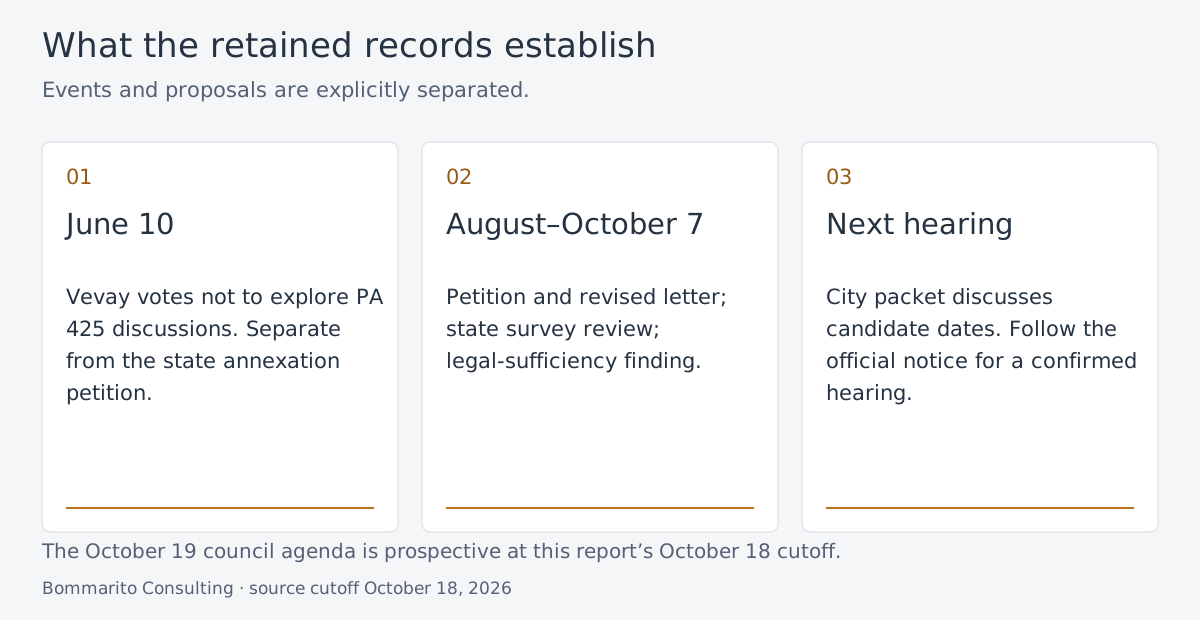
On June 10, the Vevay board voted unanimously not to enter discussions or explore the proposed PA 425 arrangement. The June 15 council packet includes the city manager's June 12 account of negotiations and a timeline. That memorandum says the developer intended to pursue annexation directly through the statutory process after the township decision. This sequence is supported by the documents; conclusions about why individual officials preferred one approach require separate attribution.33,31
The submission and revision dates require separate labels
The petition cover letter is dated August 6 and marked revised August 20. The September 9 state review says the petition was filed August 8. These dates describe different parts of the record. An amended cover letter does not automatically establish a new statutory filing date, and a preliminary submission date should not automatically be used to calculate a hearing window that depends on a sufficient petition.23,11
The September review finds the survey and legal description substantially accurate and consistent and states that the territory is contiguous with Mason. It identifies earlier boundary records and a PA 425 area when explaining the common boundary. The existence and terms of a historical agreement should be read in the retained exhibits before assigning it a present legal effect.23
October opened the hearing stage
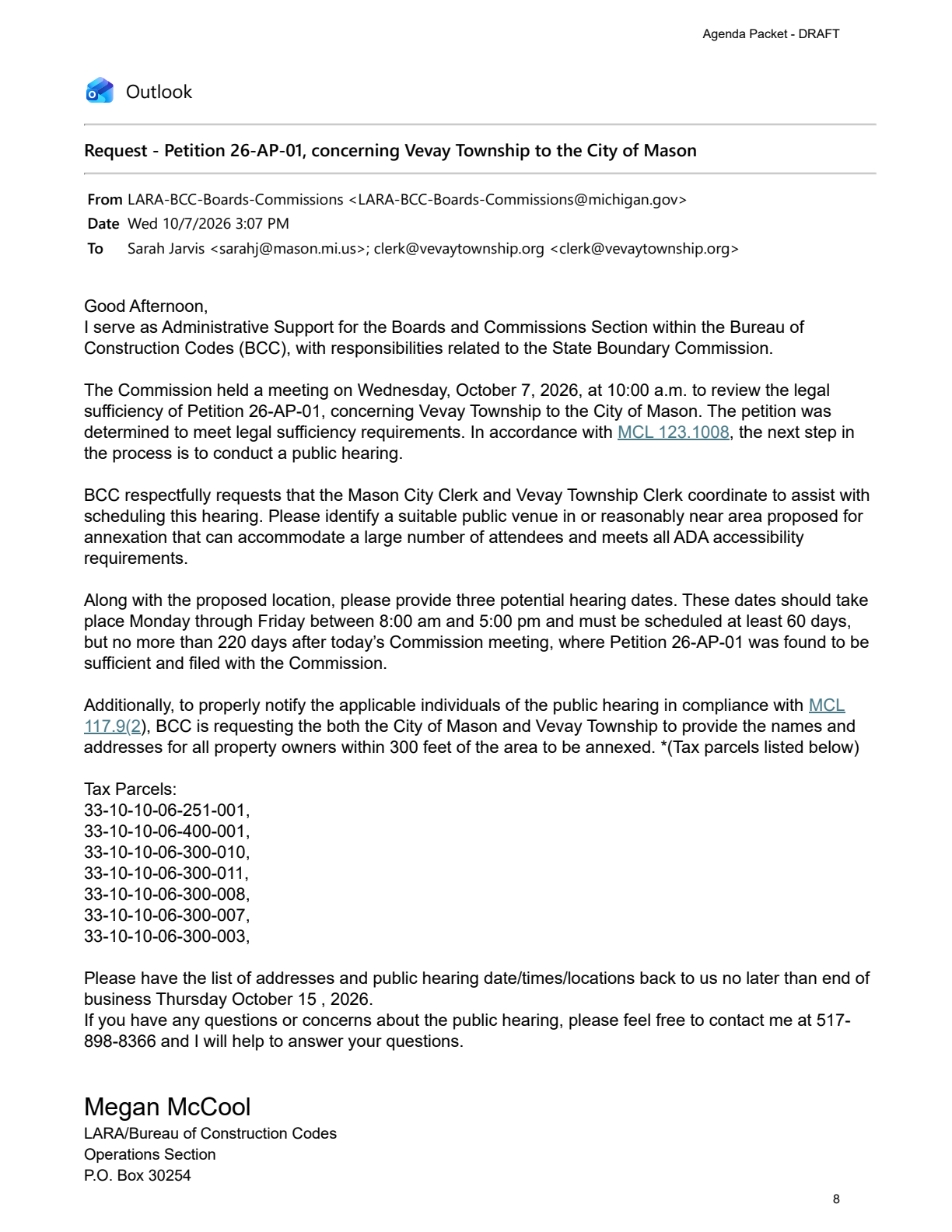
The State Boundary Commission's October 7 agenda lists legal-sufficiency review of 26-AP-01. An email sent that afternoon confirms the petition was found sufficient and asks the city and township clerks to coordinate a suitable hearing venue and potential dates. The same correspondence requests information needed to notify nearby property owners.4,23
The city staff report says the manager and clerk spoke with commission staff on October 13 to clarify the requests and deadlines. An October 14 follow-up sets October 20 as the response date for proposed hearing arrangements and says an evening hearing can be accommodated if it would better serve public participation. This is correspondence about arranging a hearing, not the hearing notice itself.23
The next council packet is evidence of preparation
The October 19 packet includes the legal-sufficiency material and city attorney Thomas Hitch's October 14 memorandum on the annexation process. As of the October 18 source cutoff, that council meeting has not occurred. The packet supports statements about the documents posted and the actions proposed for receipt; it does not prove a council vote at the upcoming meeting.23
The staff report lists possible December and January dates and describes coordination with the township. None of those candidate dates should be advertised as a confirmed public hearing without the later official notice. Keep the public-hearing date, the clerks' administrative response deadline, and the next ordinary council meeting in separate calendar entries.23
Chapter 4
What the state must consider
The merits inquiry is broader than the paperwork check
MCL 117.9(2) gives the Commission powers and duties tied to the State Boundary Commission Act when processing the annexation petition. The statutory criteria include population and land use, service needs and fiscal effects, the effect on the whole community, and the relationship to established land-use plans. The legal-sufficiency review does not answer all of those merits questions.8,12
Population, density, land area, assessed valuation, topography, natural boundaries, drainage basins, and probable growth are expressly relevant. Comparative information about the receiving municipality and the remaining township is part of the framework. This makes a supported account of the territory and surrounding community more useful than an isolated statement that the land is either agricultural or economically valuable.12
Public services require a record
The statute asks about the need for organized services, current cost and adequacy, likely future needs, the practicality of supplying services, and the effects of alternative actions on both the territory and the remaining community. It also addresses expected tax increases in relation to benefits and the municipality's financial ability to maintain urban services.12
The petitioners say city utilities are needed for the proposed project. That statement supplies a reason for their request; it does not by itself establish available water or wastewater capacity, the timing of infrastructure work, or an enforceable assignment of project costs. Those claims should lead to engineering records, adopted agreements, and financial terms, with assumptions stated clearly.23,12
For a resident assessing a service claim, useful questions include what existing capacity is available, what construction would be needed, who would pay, when service would begin, and how the remaining township would be affected. The answers should distinguish existing conditions from a proposed future development scenario. A projected large customer and an executed utility-service commitment are different forms of evidence.12,23
Community effects and plans matter
The statute directs attention to the general effect on the entire community and to established city, township, county, and regional plans. A submission can therefore connect specific land-use or service concerns to the adopted planning record and the proposed boundary. The relevant question is how the evidence bears on the statutory inquiry, rather than whether a participant can produce the largest number of general statements for or against data centers.12
The October 14 city attorney memorandum advises that the city's input should be factual and related to the statutory criteria. It describes a questionnaire and opportunities for submissions and public-hearing presentations. That is the city's attorney's advice to the council; the controlling requirements still come from the statutes, applicable rules, and commission notices.23
A recommendation, an order, and an effective date are different
The Commission's own webpage describes its role in evaluating the record and recommending approval or denial of specified boundary petitions, with possible changes to the proposed territory. The Home Rule City Act also addresses approval, referendum conditions, distribution of an order, and an effective date. A public summary should identify the exact document and stage instead of collapsing all state action into “the state approved it.”19,8
Chapter 5
Notice, hearings, population, and referendum
A public hearing follows a sufficient petition
MCL 123.1008(3) describes a hearing at least 60 but not more than 220 days after filing of a sufficient petition, subject to the statutory priority provision. MCL 117.9(2) requires the hearing in or reasonably near the proposed annexation area. The October 7 BCC correspondence asks the clerks to coordinate a suitable accessible venue and dates within the stated process.11,8,23
The filing of an initial document and the sufficient-petition event should not be treated as the same date without the record establishing that relationship. In this case, BCC's October correspondence and later scheduling clarification are particularly useful for understanding how staff are arranging the next step. Readers should rely on the actual hearing notice for the confirmed date, place, submission instructions, and any stated deadlines.23
Nearby owners receive specified notice
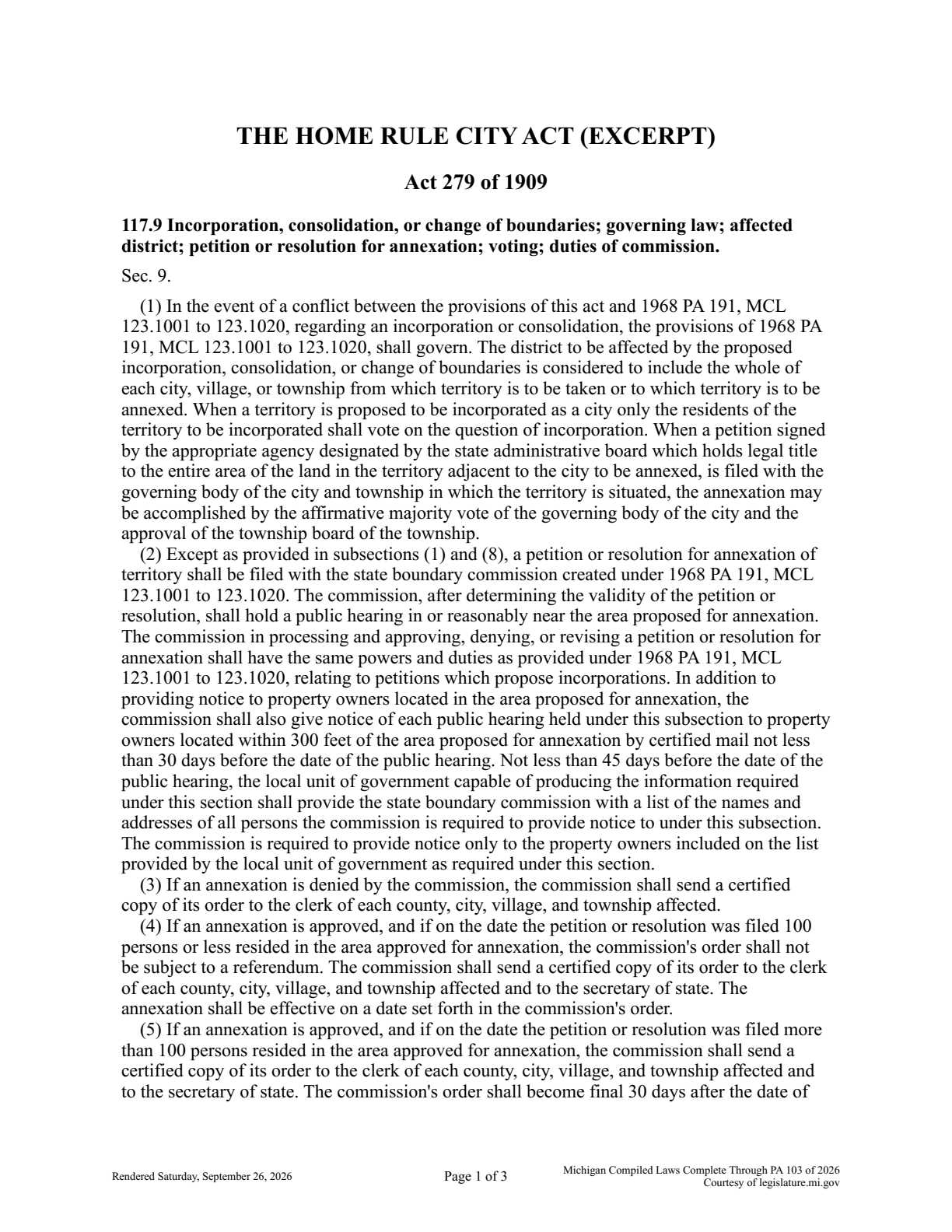
MCL 117.9(2) requires notice to property owners in the proposed territory and to owners within 300 feet, with the specified nearby-owner notice by certified mail at least 30 days before the hearing. It requires the capable local unit to provide the commission's owner-address list at least 45 days before the hearing and limits the commission's notice obligation to owners on that provided list. The BCC correspondence seeks that information from the city and township.8,23
A statutory mailing radius is not the boundary of public interest. It tells the reader about a particular notice obligation. The public hearing and comment process should be read from the applicable notice and rules; receiving or not receiving a certified letter should not be assumed to answer every question about participation.8,11
Population affects the annexation referendum rule
Under MCL 117.9(4), if an annexation is approved and 100 or fewer persons resided in the approved area on the date the petition or resolution was filed, the commission's order is not subject to a referendum under that provision. The statute separately addresses an approved area with more than 100 residents and the conditions for a referendum petition. The relevant measure is persons residing in the territory at filing, not simply registered voters or the number of signers.8
The revised petition cover letter reports eight residents based on owner information. The October city attorney memorandum anticipates that the land will be vacant and discusses the 100-person rule. Those statements should not be merged into an independently verified population finding: the relevant date and measure must be established. This report attributes the count to the petition and does not publish household identities.23
The PA 425 rule uses a different test
For a PA 425 contract, MCL 124.25 provides a different referendum mechanism. Among its provisions, a petition by at least 20 percent of registered electors residing in the property, filed within 30 days after the section 4 hearing, can require a vote in the local unit. The act also addresses territory with no registered electors and a governing-body resolution calling for a referendum. Those are not the population and petition rules for the present state annexation proceeding.16
A number such as eight residents in an annexation filing cannot be substituted for a registered-elector count in a different PA 425 procedure. Likewise, an old discussion about how many signatures could trigger a contract referendum does not establish a present annexation referendum right. The legal mechanism, eligible population, triggering event, and filing place must all match.8,16
Submissions and review continue to matter
The city attorney's memorandum describes written submissions before the public hearing closes and a later response opportunity, and identifies judicial review under MCL 123.1018. The statute provides that every final commission decision is subject to judicial review; the applicable forum and procedure should be confirmed from the current governing law and final order. Participants should confirm the actual procedural instructions and any deadline in the governing record. Public comment, statutory referendum, an official municipal submission, and judicial review each serve a different function.23,36
Chapter 6
A boundary decision and a development decision
A new boundary does not answer every development question
The petitioners connect the proposed annexation to the need for public utilities and a possible data center. The annexation process evaluates a boundary action under its governing statutes. That should not be represented as a complete building, zoning, utility, environmental, or operating approval for a specific future design.23,8,12
The city's project page discusses the separate roles of zoning, utility arrangements, and development controls. It is useful background, but some of its material describes Ordinance 266, which the same page identifies as repealed. Readers must distinguish a description of the earlier proposed regulatory approach from a current permission or binding requirement.18,5
Map the decisions to their documents
The boundary survey identifies the territory requested for annexation. A development site plan would identify a proposed layout and use. A utility study would address available service and needed improvements. An adopted service agreement would set the parties' enforceable terms. An environmental or drainage permission would answer the question assigned to that authority. Those documents cannot stand in for one another merely because they concern the same land.23,12
This distinction also helps explain conflicting public statements. A statement that the property is adjacent to city service does not establish that capacity is sufficient for every possible data-center load. A statement that a boundary route is available does not establish that every later land-use question is resolved. A proposal should be tracked through the specific decision and its conditions.12,23
Separate fiscal projections from commitments
The June city materials include economic-development and revenue discussions. Those discussions need to be read with the valuation assumptions, proposed service demands, timing, tax treatment, and costs. A large projected benefit can be important to a policy debate without being an enforceable guarantee. A draft sharing concept from unsuccessful negotiations is not an executed contract.31,33
For any fiscal comparison, identify the assessment base, tax rate, exemptions, government receiving the revenue, service obligations, and year being modeled. If a later report calculates a scenario, it should retain the inputs and distinguish one-time investment, annual taxable value, annual revenue, and construction-period effects. This report does not convert the earlier negotiation figures into a forecast.12,31
The city's role includes evidence and response
The October 14 city attorney opinion states that Mason cannot unilaterally reject an annexation if it occurs. It also describes ways the city can supply information and participate in the hearing process. These propositions should be attributed to the legal opinion and read with the statutes, rather than paraphrased as a finding that the city either has no role or can decide the whole matter by itself.23
The same care applies to the township. Its June vote ended its participation in the proposed PA 425 discussions at that point. The owner-petition route is a separate statutory proceeding with its own rights, criteria, and record. The June motion's text is the proper source for what the township voted to do.33,8
Chapter 7
What happens next and what to monitor
Start with the current procedural state
At the October 18 source cutoff, the retained BCC correspondence confirms legal sufficiency and identifies the public hearing as the next step. The posted October 19 council packet lists proposed hearing arrangements and receipt of the attorney opinion. The upcoming council meeting and the eventual state public hearing are separate events.23
The staff report proposes dates in December and January after discussions with state staff. These are candidates, not an advertised hearing date. The October 20 request concerns the clerks' response about scheduling. A resident should therefore look for the later official public-hearing notice before making travel plans or treating a candidate date as a filing deadline.23
A practical record checklist
Keep the petition and revised cover letter, legal description, survey, state staff review, commission sufficiency record, hearing notice, municipal questionnaire responses, public submissions, and eventual recommendation or order together. The retained October packet is valuable because it assembles many of the early documents, but later developments will require later records.23,19
When checking a new document, record who issued it, what action it actually takes, when that action occurred, what conditions remain, and which earlier version it replaces. A packet can contain a draft recommendation, an already issued letter, a signed historical agreement, and an applicant's advocacy. Their inclusion in one PDF does not give them the same authority.23
Useful questions for the public hearing record
The statutory criteria provide a structure for concrete questions: What services are needed? What evidence establishes capacity and cost? How would the boundary change affect the remaining township? How does the proposed action relate to the relevant land-use plans? What assumptions about population, future use, and taxation support the petition? Those questions should lead to particular records and accountable statements.12
A submission can support or oppose the petition while remaining specific about the requested action and evidence. For example, a concern about infrastructure costs can identify the relevant service, the proposed improvement, and the missing or disputed financial term. A land-use concern can identify an adopted planning provision and the relationship of the proposed boundary to that plan.12
Questions that remain open in this account
The exact treatment of the right-of-way exception should be checked against the survey and legal description before using acreage for an independent calculation. The filing-date resident count requires verification if it is used to determine referendum availability. Any continuing legal effect of a historical growth or PA 425 agreement requires the executed instrument and applicable law. The identity and commitments of a proposed operator require their own documentation.23,8
Those questions do not erase the documented process. They identify where the record should become more precise before a stronger conclusion is offered. The key established distinction remains: an owner-initiated petition has passed a paperwork threshold and is proceeding toward a hearing; the final boundary and development decisions must be identified from their own later records.23
Original evidence
Read the documents.
These are pages from the retained original records. Follow the links to read the complete document and its context.
Petition appendix one boundary survey ↗
PDF page 17 of 240
State staff legal sufficiency review ↗
PDF page 12 of 240
BCC correspondence on the hearing stage ↗
PDF page 8 of 240
Annexation hearing and referendum law ↗
PDF page 1 of 3
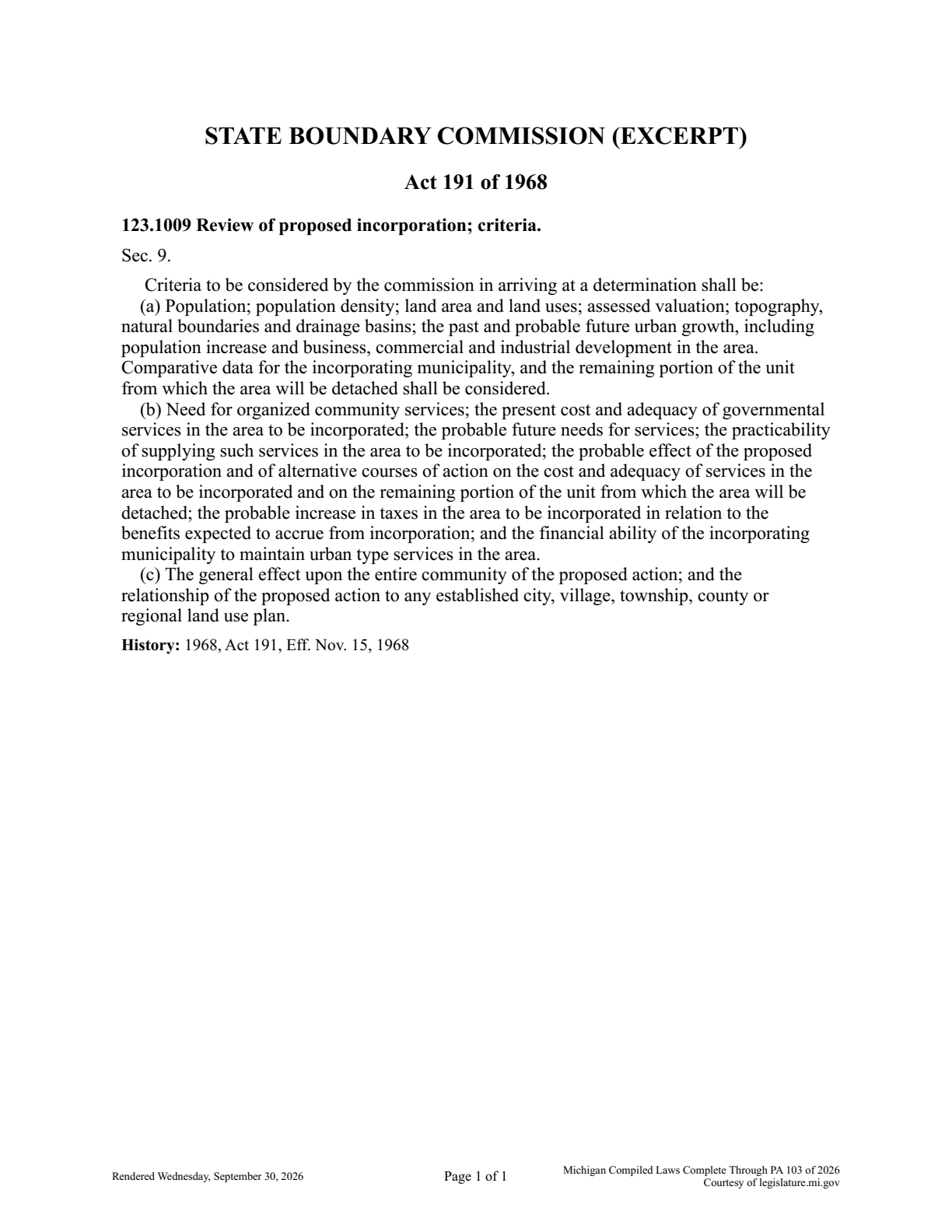
State statutory review criteria ↗
PDF page 1 of 1
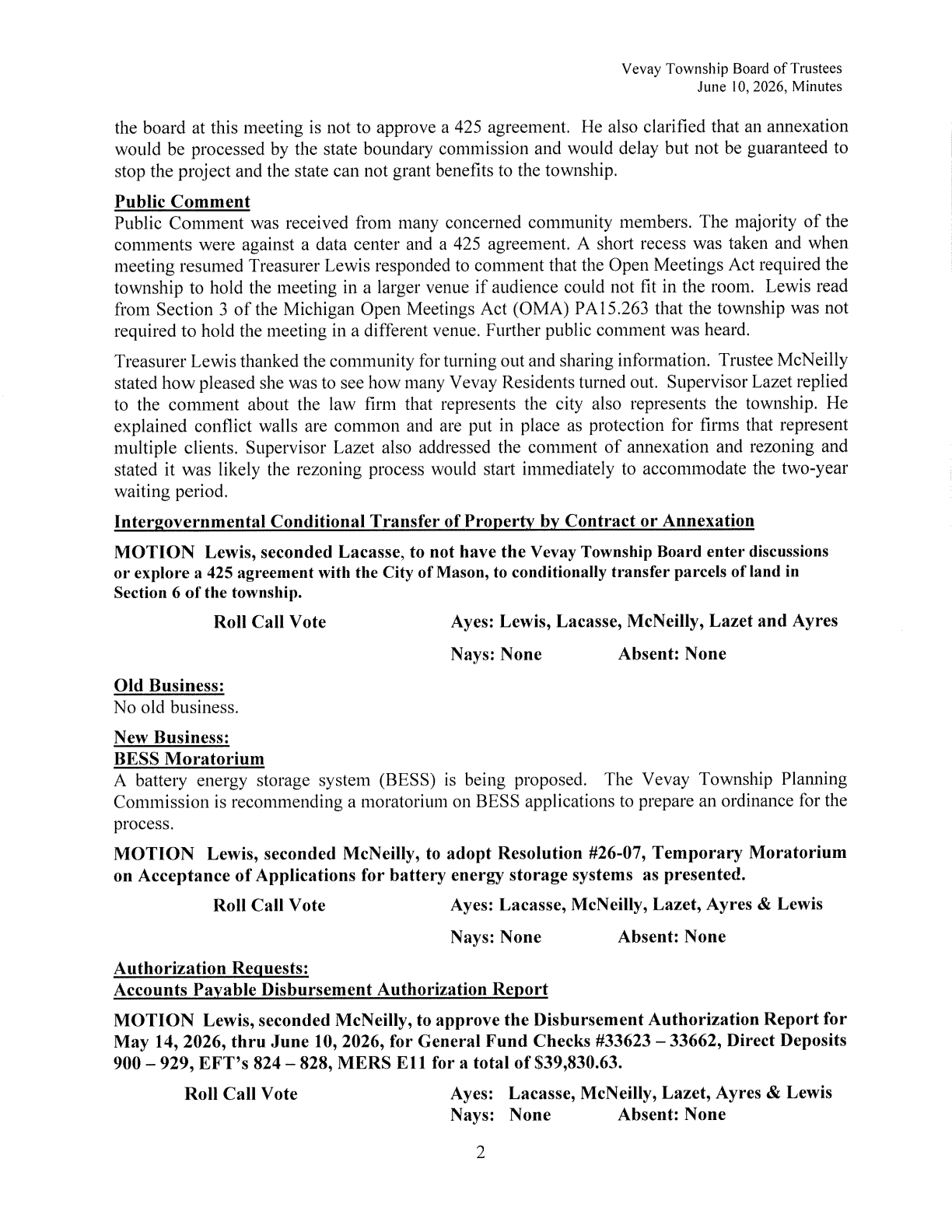
Township motion declining PA 425 discussions ↗
PDF page 2 of 4
Keep the record together
The detailed report
14 pages with cited chapters, original records, and a source register.
Sources and primary authorities · 36 records
- City of Mason official website ↗
Original record · Checked 2026-10-18
- Vevay Township official website ↗
Original record · Checked 2026-10-18
- Vevay Township meeting records ↗
Original record · Checked 2026-10-18
- State Boundary Commission October 7 2026 agenda ↗
Original record · Checked 2026-10-18
- Mason March 16 2026 final council minutes ↗
Original record · Checked 2026-10-18
- Mason June 1 2026 council packet ↗
Original record · Checked 2026-10-18
- Mason charter and ordinances index ↗
Original record · Checked 2026-10-18
- MCL 117.9 ↗
Original record · Checked 2026-10-18
- MCL 117.9a ↗
Original record · Checked 2026-10-18
- MCL 123.1001 ↗
Original record · Checked 2026-10-18
- MCL 123.1008 ↗
Original record · Checked 2026-10-18
- MCL 123.1009 ↗
Original record · Checked 2026-10-18
- MCL 123.1011 ↗
Original record · Checked 2026-10-18
- MCL 124.21 ↗
Original record · Checked 2026-10-18
- MCL 124.24 ↗
Original record · Checked 2026-10-18
- MCL 124.25 ↗
Original record · Checked 2026-10-18
- MCL 124.26 ↗
Original record · Checked 2026-10-18
- Mason M-3 Technology Innovation District project records ↗
Original record · Checked 2026-10-18
- State Boundary Commission official records ↗
Original record · Checked 2026-10-18
- State Boundary Commission petition application process ↗
Original record · Checked 2026-10-18
- Vevay Township board and committee listings ↗
Original record · Checked 2026-10-18
- Mason City Council agendas and minutes ↗
Original record · Checked 2026-10-18
- Mason council 20261019 packet ↗
Original record · Checked 2026-10-18
- Mason council 20261005 packet ↗
Original record · Checked 2026-10-18
- Mason council 20260921 packet ↗
Original record · Checked 2026-10-18
- Mason council 20260921 minutes ↗
Original record · Checked 2026-10-18
- Mason council 20260914 packet ↗
Original record · Checked 2026-10-18
- Mason council 20260914 minutes ↗
Original record · Checked 2026-10-18
- Mason council 20260817 packet ↗
Original record · Checked 2026-10-18
- Mason council 20260817 minutes ↗
Original record · Checked 2026-10-18
- Mason council 20260615 packet ↗
Original record · Checked 2026-10-18
- Mason council 20260615 minutes ↗
Original record · Checked 2026-10-18
- Vevay Township board June 10 2026 minutes ↗
Original record · Checked 2026-10-18
- Vevay Township board July 15 2026 minutes ↗
Original record · Checked 2026-10-18
- Vevay Township board May 13 2026 minutes ↗
Original record · Checked 2026-10-18
- State Boundary Commission judicial review: MCL 123.1018 ↗
Original record · Checked 2026-10-18
Prepared by Bommarito Consulting from the cited statutes and public records. Source cutoff: October 18, 2026. Later orders, notices, amendments, and decisions can change the applicable process or project status.